Full-Kitchen Price Range
Most full professional kitchen projects fall between $2,000 and $7,000, with an average near $4,000.
For Phoenix homeowners, Phoenix Painter Co. uses cabinet opening count and finish condition to explain why professional cabinet painting can cost $2,000-$7,000 for a full kitchen, with typical pricing of $125-$185 per door or drawer. The total matters because preparation, wood condition, color changes, and finish quality can shift the bid more than square footage alone.
Most full professional kitchen projects fall between $2,000 and $7,000, with an average near $4,000.
Each door or drawer typically adds $125-$185 when the price covers both sides, edges, and rehanging.
Grease buildup, dents, visible grain, oxidized wood, and a dramatic color change add preparation and may require stain-blocking primer before spraying.
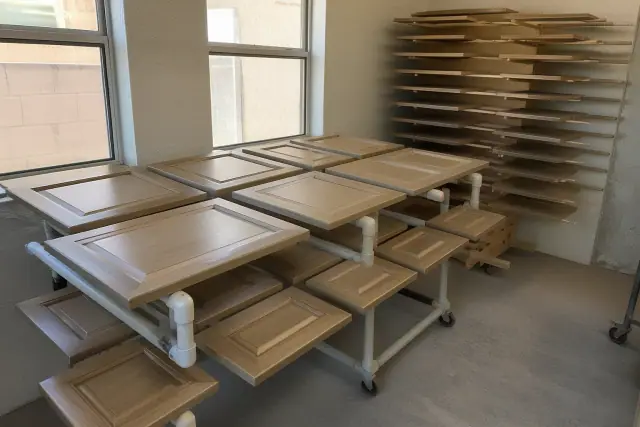
A view of every tagged door and drawer shows why opening count predicts labor more accurately than cabinet square footage.
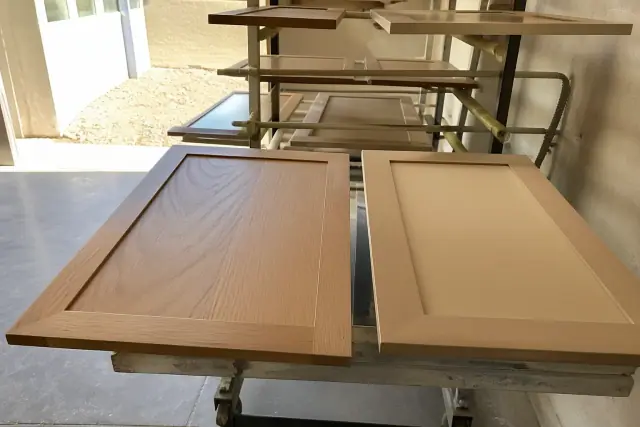
Close-up surfaces reveal how oxidized oak can need more preparation than newer maple or MDF before primer and finish coats.
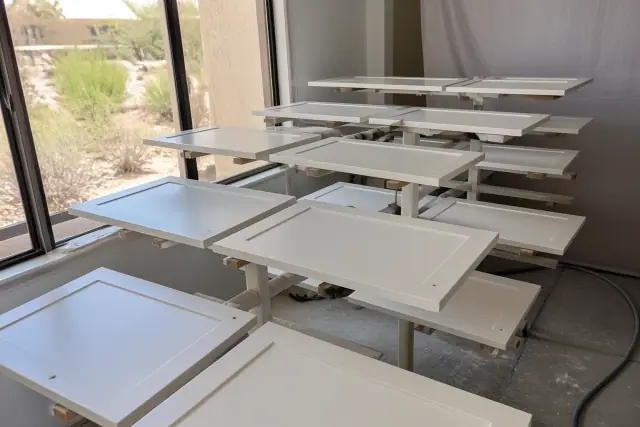
A controlled spray setting illustrates how coatings level without brush marks while doors and drawers stay organized for accurate rehanging.
A small galley with 10-15 openings typically falls between $1,200 and $2,200.
An average kitchen with 20-30 openings commonly runs $2,500-$4,500.
A large or open-concept kitchen with 35-50+ openings often costs $5,000-$7,500+.
Stripping the old finish, repairing wood, and applying a factory-grade topcoat can bring a full refinishing scope to $4,000-$10,000.
| Project | Typical Scope | Cost Range | Main Cost Driver |
|---|---|---|---|
| Bathroom cabinets | Usually 6-12 openings | $600-$1,500 | Small scope with the same detailed prep steps |
| Bedroom built-ins | Cabinetry or closet units | $600-$1,800 | Unit count and built-in complexity |
| Single vanity | One vanity cabinet | $250-$600 | Door and drawer count |
| Double vanity | Two-sink primary-suite vanity | $500-$1,000 | Extra openings and surface area |
| Garage cabinets | Utility-grade MDF or plywood | $400-$1,200 | Material condition and heat-resistant finish choice |
A professional scope covers degreasing, sanding every surface to 120-150 grit, filling grain and dents, bonding primer, and two sprayed coats on doors, drawers, and face frames. Doors and drawers are removed, tagged, finished in a controlled environment, and rehung after curing. Very small or limited projects may start around $300, while local standard-scope data centers near $763, with most homeowners spending $326-$1,208; basic kitchen jobs average $750-$1,250, and full professional work with premium coatings runs $2,000-$7,000.
Opening count is the clearest starting point, and kitchens with 25+ openings, glass inserts, crown molding, or interior box painting trend higher. Square-foot pricing of $5.40-$10.79 is available but less precise for cabinetry; smaller touch-up work may instead be quoted at $20-$50 per hour. Labor typically represents 60-70% of the total, while primer, coatings, and other materials run 15-25%. Grease, water damage, or heavy staining can add $300-$600 in preparation, and a full kitchen commonly takes 4-7 business days after drying and cure time are included. Older oxidized oak in Arcadia or Ahwatukee may need more work than newer maple or MDF in Verrado or Estrella, while desert dust, intense UV exposure, and west-facing windows also affect finish and sheen choices.
Is painting cheaper than replacement? Usually: refacing often costs $5,000-$15,000, new cabinetry can run $10,000 or more, and painting is generally 30-60% less when the cabinet boxes are sound. Is professional painting worth it? A properly sprayed catalyzed or urethane finish can last 8-15 years, compared with 2-4 years for many brush-applied DIY finishes. How should bids be compared? Look for an itemized opening count, preparation steps, coating type, and timeline, and be cautious of prices under $100 per door that may omit proper degreasing or priming.
Count your doors and drawers, note the current finish and any grease, staining, water damage, or wood repair, then request a written scope that separates preparation, coatings, and timeline before work begins.